
Usually, no. A dental practice only needs a standalone city page when it helps patients in that specific town make a distinct decision about driving to your office. If five neighboring suburbs share the exact same clinic, the same procedures, and the same arrival instructions, spinning up five near-identical pages wastes your budget and triggers Google's doorway-page filters.
Here is the single best sentence we have seen on a dental suburb page:
"There is no satellite office in Lone Oak."
That line sits right on Smile Station's page for Lone Oak, Kentucky. The practice states plainly that all treatment happens at its Paducah clinic, then gives Lone Oak families exact driving directions and scheduling options.
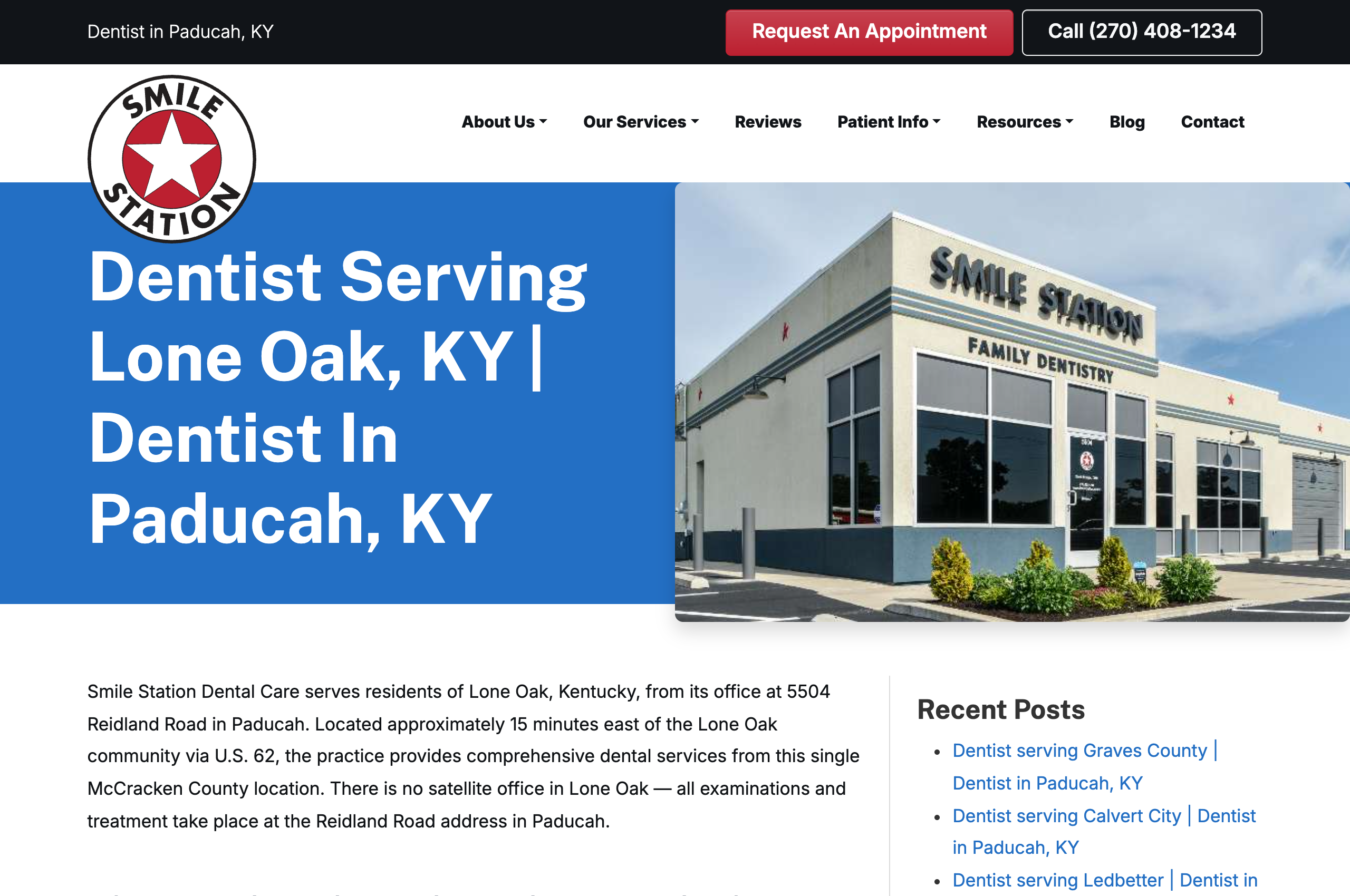
Why does that sentence work so well? Because it respects the patient's intelligence. Someone searching `dentist in Lone Oak KY` just realized you aren't down the street; you're in the next town over. Instead of tricking them with a fake local headline and hoping they don't notice the footer address, the page answers their real question immediately: *where is the office, and is it worth the short drive?*
That is the job of every regional or city page in dental SEO: tell the truth about where care happens, justify the trip, and make arrival effortless.
What a dental city page actually needs to tell patients
Most dental marketing agencies sell "local SEO expansion packs" by taking your homepage copy, swapping fifteen suburb names into the H1 tag, and stuffing three paragraphs of Wikipedia trivia about local parks and school districts at the bottom.
No patient with a cracked molar or a teenager needing Invisalign reads your dental website to learn when their suburb was incorporated.
If your practice doesn't have a physical building in the city named in the headline, your page has to do four concrete jobs within the first scroll:
- Name the real treatment location immediately: Give the exact street address, suite number, and city where the patient will sit in the chair.
- Justify why patients pass closer offices to visit yours: Highlight the specific clinical capabilities that make a 15-to-25-minute commute worthwhile, such as IV sedation, CBCT-guided dental implants, pediatric specialty care, Friday/Saturday hours, or in-network PPO coverage.
- Give verified route and parking instructions: Tell drivers which highway exit to take, which lot they are allowed to park in, and how long the trip takes during normal clinic hours.
- Provide a direct booking or insurance check path: Let the commuter verify their insurance plan and book without calling three times.
The contradiction you must fix before publishing another suburb page
Adding more city pages without an operational review usually introduces contradictions that erode patient trust.
Look at Trusted Dental Care's Royse City page. It does the right thing by identifying the actual clinic in Wylie, Texas, and listing office hours and directions. Look closer at the travel copy, however: one paragraph tells the reader the clinic is a 10-minute drive from downtown Royse City, while the directions block further down the exact same page describes a 29-minute trip.
Picture a busy parent trying to squeeze a hygiene visit or an emergency exam between work and school pickup. A 10-minute drive fits over a lunch hour. A 29-minute drive each way requires blocking off an entire afternoon. When your own page gives two conflicting answers, the patient hesitates and clicks back to Google to find an office that is actually close.
Before you let an agency publish a single new suburb URL, bring your front desk into the review. Ask which landmark the driving estimate starts from, what traffic looks like at 8 a.m. and 4 p.m., and who owns updating those pages when hours or routes change. We cover that exact operational checklist in our guide to dental website maintenance for city pages.
When one consolidated service-area page beats ten thin city pages
You don't need ten separate URLs to capture searches from adjacent neighborhoods. Second Line Family Dentistry in Metairie, Louisiana uses a single, clean regional page that identifies its Metairie clinic and explicitly welcomes patients from Elmwood, Kenner, New Orleans, and surrounding Jefferson Parish communities, complete with the single office address and hours.
When your neighboring communities share the same highway corridor, the same appointment process, and the same clinical offering, one authoritative "Areas We Serve" hub (plus strong neighborhood signals on your primary location and treatment pages) outperforms a dozen thin doorway clones.
Why? Because Google's doorway-abuse policy specifically targets websites that create multiple city-targeted pages designed to funnel visitors into the same single destination without unique local value. Consolidating thin suburb pages onto one strong hub concentrates your internal links and keeps your crawl footprint clean.
Why "we're nearby" is never a complete answer
A national study published in JAMA Network Open analyzing geographic access to dental clinics highlighted a reality every practice owner sees at the front desk: raw mileage on a map does not equal real-world patient access. Driving-time estimates assume the patient has a car at that hour, knows where to park, and knows whether the clinic takes their coverage.
Translate that directly into how you write your location and commuter pages:
- Explain transit and parking clearly: Tell patients whether parking is free in your lot or requires a garage validation, and name the exact bus or rail stop if your clinic sits on a transit corridor (see our breakdown on dental website directions and patient access).
- State insurance and payment rules in plain English: Tell commuters how to verify their PPO plan before they make the drive.
- Clarify what clicking "Book" actually does: Make it unmistakable whether your online form books a confirmed chair time or submits a request that the front desk has to call back to confirm.
How to decide whether another city page is worth building
Before you approve an agency's pitch to build another batch of suburb pages, force the team to complete this sentence with verified facts:
A patient in [Suburb A] will drive past closer dentists to our clinic in [City B] for [Specific Procedure / Access Advantage] because [Verified Clinical or Scheduling Reason].
If the only way you can finish that sentence is *"because we are friendly and care about your smile,"* do not build the page. Use this five-point gate instead:
| Diagnostic Question | What You Need Before Approving a Separate URL | When to Consolidate Onto Your Main Location Page Instead |
|---|---|---|
| 1. Where does treatment actually happen? | Explicit opening statement naming the real clinic address with zero fake local office implication | The draft tries to hide the real city address until the footer |
| 2. What makes the commute worth it? | A concrete clinical draw (implants, sedation, pediatric specialist, same-day crowns, weekend hours, specific insurance) | The services offered are identical to every general dentist in the patient's own town |
| 3. Are the route & arrival details distinct? | Verified highway/transit route, accurate drive time, and parking instructions specific to that corridor | The directions are just a generic Google Maps embed |
| 4. Is there real non-brand search demand? | Verified monthly searches in Google Search Console or DataForSEO for `dentist [suburb]` or `[treatment] [suburb]` | Zero search volume; agency is just filling a monthly "4 pages per month" deliverable quota |
| 5. Who maintains the operational facts? | A named owner who updates hours, providers, and booking links across every city page simultaneously | Nobody tracks where office hours or scheduling rules are repeated across the site |
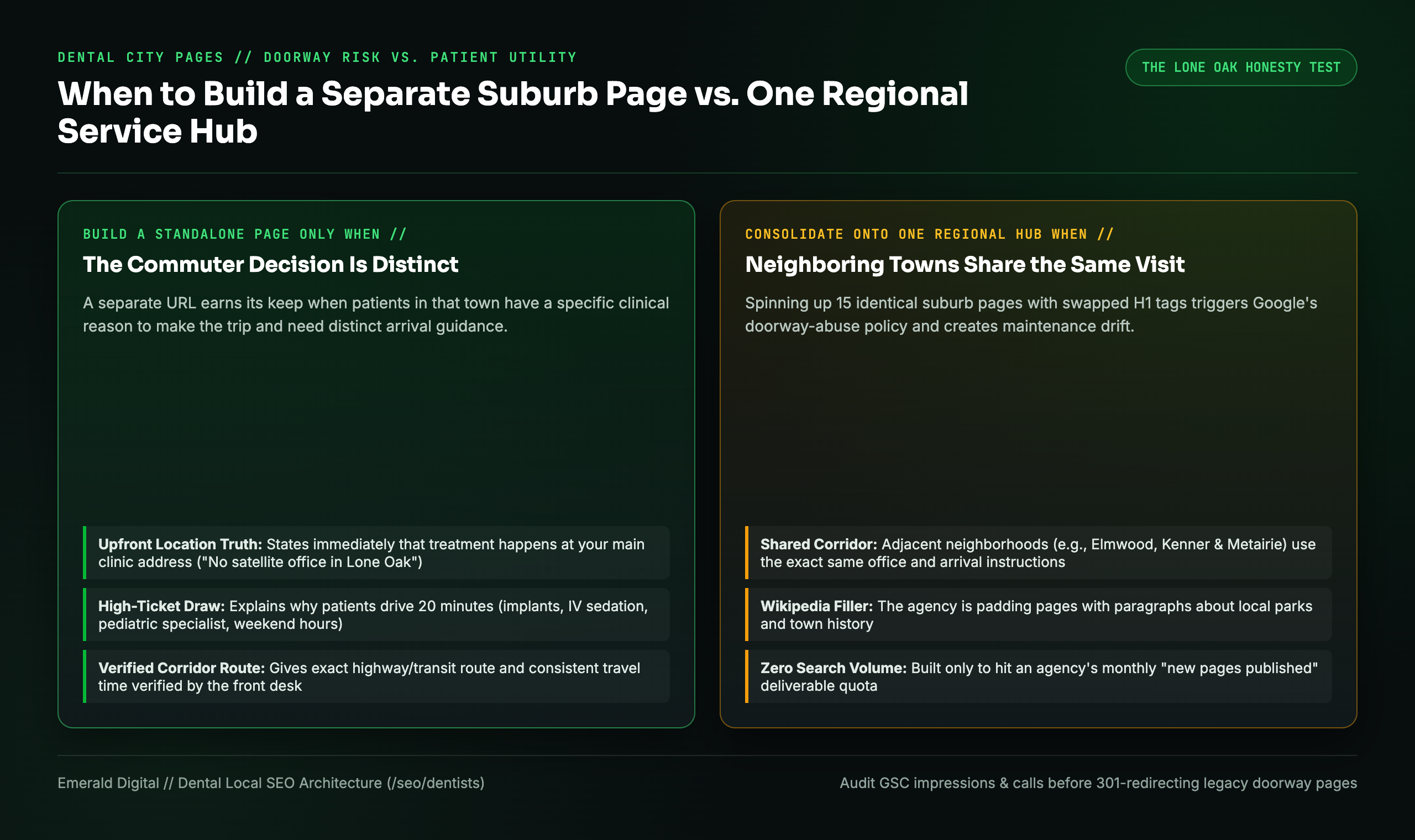
If you already have ten or twenty suburb pages live on your domain, don't delete them all overnight. Run a quick audit in Google Search Console first: keep and upgrade the 2 or 3 pages that actually generate non-brand impressions and phone calls, rewrite them so they pass the Lone Oak honesty test, and 301-redirect the zero-traffic doorway pages into your primary location hub.
See how we build local search and Map Pack authority for dentists, or request a free dental SEO teardown: we will audit your current location and treatment pages, show you which URLs are helping or hurting your rankings, and map the fastest path to more booked patients.