Personal injury is the most competitive corner of search. Not just legal search. All of search.
A single commercial truck wreck, catastrophic injury, or wrongful death retainer can be worth six or seven figures in fees. Every firm in your metro knows the math, which is why paid clicks for personal injury keywords routinely clear $150 to $250 each and national aggregators spend millions defending page one. Most managing partners respond by throwing more money at shared lead vendors or hiring an agency to publish four generic blog posts a month.
The firms that actually take market share do something much more disciplined. They build dedicated commercial pages for every high-value case type, lock down the local Map Pack, extract real trial experience from their attorneys, and track every organic call to signed retainers.
We know this playbook works because we ran it in the hardest vertical in the country. We took The Law Center to #2 nationally for "motorcycle accident lawyer" in six months, generating 5,800+ qualified contacts, 155,000 organic users, 235,000 pageviews, and a 5x increase in signed cases. Here is how the system works.
Rank for the case, not your firm name
Open your Google Search Console performance report and filter out every search containing your firm's name or your partners' last names. In eight out of ten law firm audits we run, branded searches account for 70% to 85% of the clicks the previous SEO agency took credit for.
People typing your firm name were already looking for your phone number. Ranking for your own name isn't marketing. It's a directory listing.
Signed cases come from non-branded practice-area and local queries typed by someone who just got hurt and doesn't know which lawyer to call yet. Your site architecture has to map one primary commercial URL to each specific injury and geography combination you want to sign.
| Case Tier & Search Intent | Example Target Queries | Required Page Architecture | Primary Conversion Proof |
|---|---|---|---|
| Core Metro Practice Hubs | `personal injury lawyer [city]`, `injury attorney near me` | Comprehensive metro pillar page with sub-navigation to every vehicle and catastrophic case type | Total verdicts recovered, trial readiness, 24/7 intake response, local courthouse proximity |
| High-Value Vehicle Cases | `motorcycle accident lawyer [city]`, `18 wheeler accident attorney [city]`, `car accident lawyer [city]` | Dedicated standalone URL per vehicle class (never lumped into one generic "auto accidents" page) | Commercial carrier policy limits, reconstruction investigation steps, vehicle-specific case results |
| Catastrophic & Specialty Claims | `wrongful death lawyer [city]`, `traumatic brain injury attorney [city]`, `construction accident lawyer [city]` | Deep commercial page written with attorney clinical and litigation insight | Life-care planning experience, expert witness network, multi-million-dollar settlement breakdowns |
| Suburb & Secondary Office Pages | `car accident lawyer [suburb]`, `personal injury attorney [county]` | Distinct location page tied to a verified office or specific local courts, hospitals, and highways | Driving directions, local review embeds, cases handled in that specific county venue |
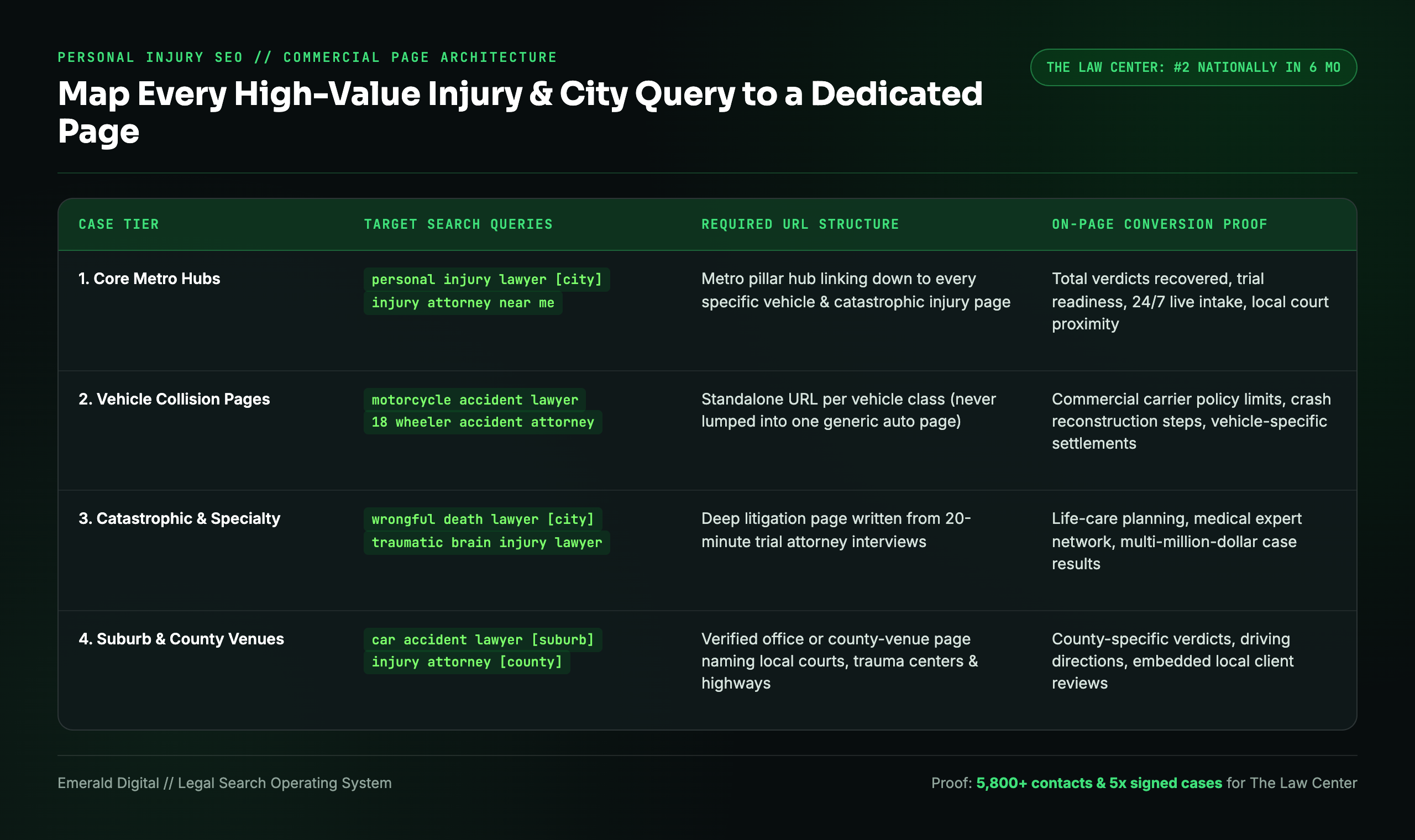
If your firm lumps car wrecks, commercial trucking collisions, motorcycle crashes, and pedestrian injuries onto a single "Motor Vehicle Accidents" page, Google will pass you over for a competitor who built a dedicated 1,500-word commercial page for each one. Separate the intents so every high-value case type has its own authoritative home. For the deeper mechanics on splitting branded from non-branded demand, read our guide on how to rank for your practice area instead of just your firm name.
Next step
Build search visibility around the cases you want.
See how we rank law firms for the cases that payOwn the Google Map Pack before chasing national blog traffic
When someone searches "car accident lawyer near me" or "personal injury attorney [city]" on a phone from an emergency room or a tow yard, the Google Map Pack sits above the organic blue links and captures the highest-intent phone calls on the page. If your firm isn't in the top three map results, you're invisible to a massive share of ready-to-hire callers.
Winning the Map Pack in a competitive personal injury market comes down to four operational levers:
- Primary category precision: Set your Google Business Profile primary category to `Personal injury attorney` if PI is your primary revenue driver, and layer `Trial attorney`, `Law firm`, and `Legal services` as secondary categories.
- Physical office reality: Google aggressively Polices virtual offices, co-working spaces, and P.O. boxes in legal search. Your profile needs a staffed physical suite, permanent signage, and consistent Name, Address, and Phone (NAP) citations across state bar directories, Avvo, Justia, FindLaw, and Super Lawyers.
- Review velocity with case context: A firm earning six new five-star reviews every single month beats a firm resting on 90 stale reviews from three years ago. Build an automated post-settlement SMS and email request tied to case closeout so happy clients naturally mention their case experience and the city.
- Landing page alignment: Link your Google Business Profile directly to a fast, conversion-engineered metro page that reinforces the exact practice areas and neighborhood signals in your profile.
The content that ranks in personal injury (and the AI slop that gets buried)
Personal injury is a strict YMYL (Your Money or Your Life) category. Google applies its highest bar for experience, expertise, authority, and trust because bad legal advice ruins lives. Generic AI-generated articles explaining "5 steps to take after a fender bender" or "what is comparative negligence" don't clear that bar. Thousands of law firms have already published the exact same boilerplate, and most of that traffic is website traffic that never turns into signed cases.
What clears the bar is content built from real litigation experience. Here is the exact editorial workflow we run:
- Interview the trial attorney for 20 minutes. We ask specific operational questions: What do commercial trucking insurers do in the first 48 hours to hide logbook violations? Why do uninsured motorist claims stall in your state? What makes a disputed-liability intersection crash winnable in your local county court?
- Write the commercial page around those specifics. We put state statute deadlines, local court venue nuances, insurance adjuster tactics, and real case examples directly onto the practice page.
- Apply the "only you can write this" test. If a paragraph could be copied onto any law firm's website in America by swapping the city name, we cut it.
"Every personal injury firm has the same list of practice areas. The asset nobody else can copy is what your attorneys actually see in depositions, mediation, and trial. When you put that specific case mechanics on the page, both Google and the injured client recognize immediately that you know what you're doing."
Matthew Berman, founder, Emerald Digital
Tone matters just as much as technical depth. Someone searching for a personal injury lawyer is usually hurt, overwhelmed by medical bills, and getting pressured by an insurance adjuster. Chest-beating slogans backfire. Calm, direct answers that explain how medical liens work, how contingency fees work, and what happens on the first call convert hesitant visitors into signed retainers.
Find the Strike Zone and push
You don't win a metro personal injury market by attacking 200 keywords at once. The fastest path to signed cases sits in your Strike Zone: commercial practice-area queries where your firm already ranks between positions 5 and 20 in Google Search Console.
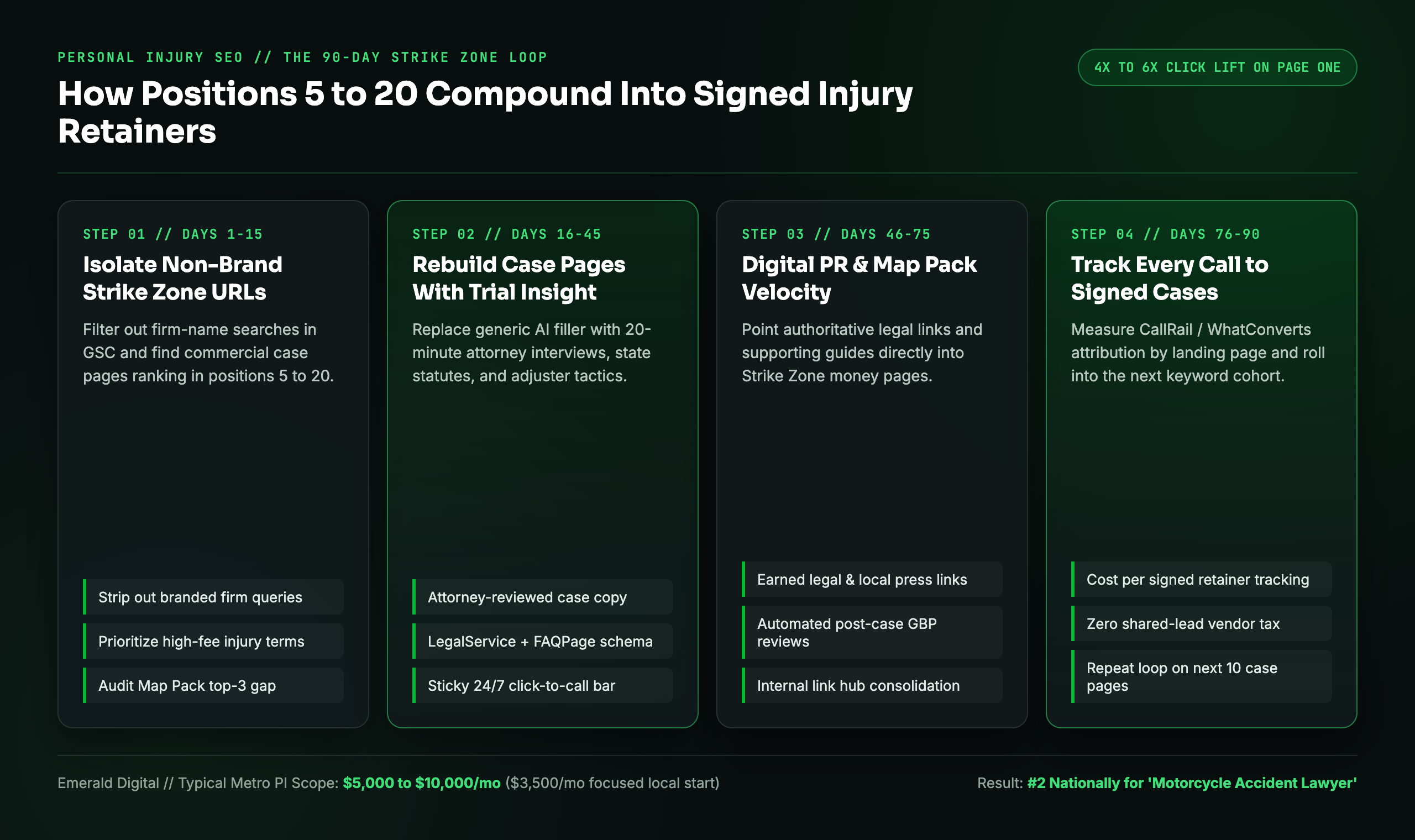
A page sitting at position 11 or 12 already has Google's trust for the topic, yet it gets almost zero clicks on page two. Moving that single commercial URL from position 12 to position 4 typically multiplies its organic clicks by 4x to 6x within weeks.
We run the Strike Zone as a weekly compounding loop:
- Isolate commercial pages in positions 5 to 20 for `[injury] lawyer [city]` and high-value vehicle terms.
- Upgrade the page depth and conversion path with attorney-reviewed FAQs, structured schema (`LegalService`, `Attorney`, `FAQPage`), and prominent click-to-call intake blocks.
- Build internal link hubs and Digital PR authority pointing directly into that commercial page until it breaks into the top three positions.
- Track every call in CallRail or WhatConverts back to the exact landing page and practice area so you know which rankings produce signed retainers.
What personal injury SEO actually costs (and why cheap retainers fail)
Before you sign an agency contract, compare their scope against the actual competitive gap in your market. We broke down the full agency landscape in our audit of the best law firm SEO companies and our guide to law firm SEO cost in 2026.
In personal injury, budget tiers determine whether you're buying real ranking power or subsidizing an agency's template machine:
- Under $2,500/month (The Template Trap): Usually buys automated blog posts, basic directory submissions, and a dashboard of branded impressions. In personal injury, this tier has zero chance of moving competitive practice-area pages or earning authoritative legal backlinks.
- $3,500 to $5,000/month (Focused Local Market): The starting floor for a focused single-market personal injury firm or a specialized niche (such as motorcycle crashes, pedestrian injuries, or nursing home neglect) in a mid-sized city.
- $5,000 to $10,000/month (Competitive Metro PI): Our typical scope for established personal injury firms competing across multiple vehicle and catastrophic injury practice areas in major metros. Covers custom commercial page builds, Google Business Profile and review systems, Digital PR link acquisition, AI search optimization, and intake attribution.
- $15,000+/month (Multi-City & Mass Tort): Built for dominant regional firms expanding across multiple offices and high-velocity mass tort or commercial trucking verticals.
Stop renting shared leads and own your market
Lead-generation resellers love personal injury firms because they can sell the exact same "car accident inquiry" to four attorneys in your zip code at the same time. You aren't buying a client. You're buying an expensive footrace against three other intake teams calling the same overwhelmed person.
Paid search still plays an important role when engineered properly. Run with strict intent separation and offline conversion tracking, Google Ads for law firms and Local Services Ads put your firm at the top of the page today. The smart play is using paid search for immediate case flow while building organic and Map Pack rankings that lower your blended cost per signed case every quarter.
We took The Law Center to #2 nationally for "motorcycle accident lawyer" in six months, driving 5,800+ contacts, 155,000 users, 235,000 pageviews, and 5x signed cases.
See how we rank law firms for the cases that pay, or request a free teardown of your market: which firms own the Map Pack and practice-area terms in your city right now, where your Strike Zone pages sit, and what it will take to overtake them.