
Prospective legal clients are no longer typing two-word fragments into Google and clicking ten blue links. More and more, they are opening ChatGPT, Perplexity, or Google Search and asking a full, specific question:
- *"Who is the best motorcycle accident lawyer in New Orleans for a disputed fault crash?"*
- *"Which Houston commercial litigation firms handle partnership freeze-outs?"*
- *"What happens if an uninsured delivery driver hits my car in Florida, and who should I call?"*
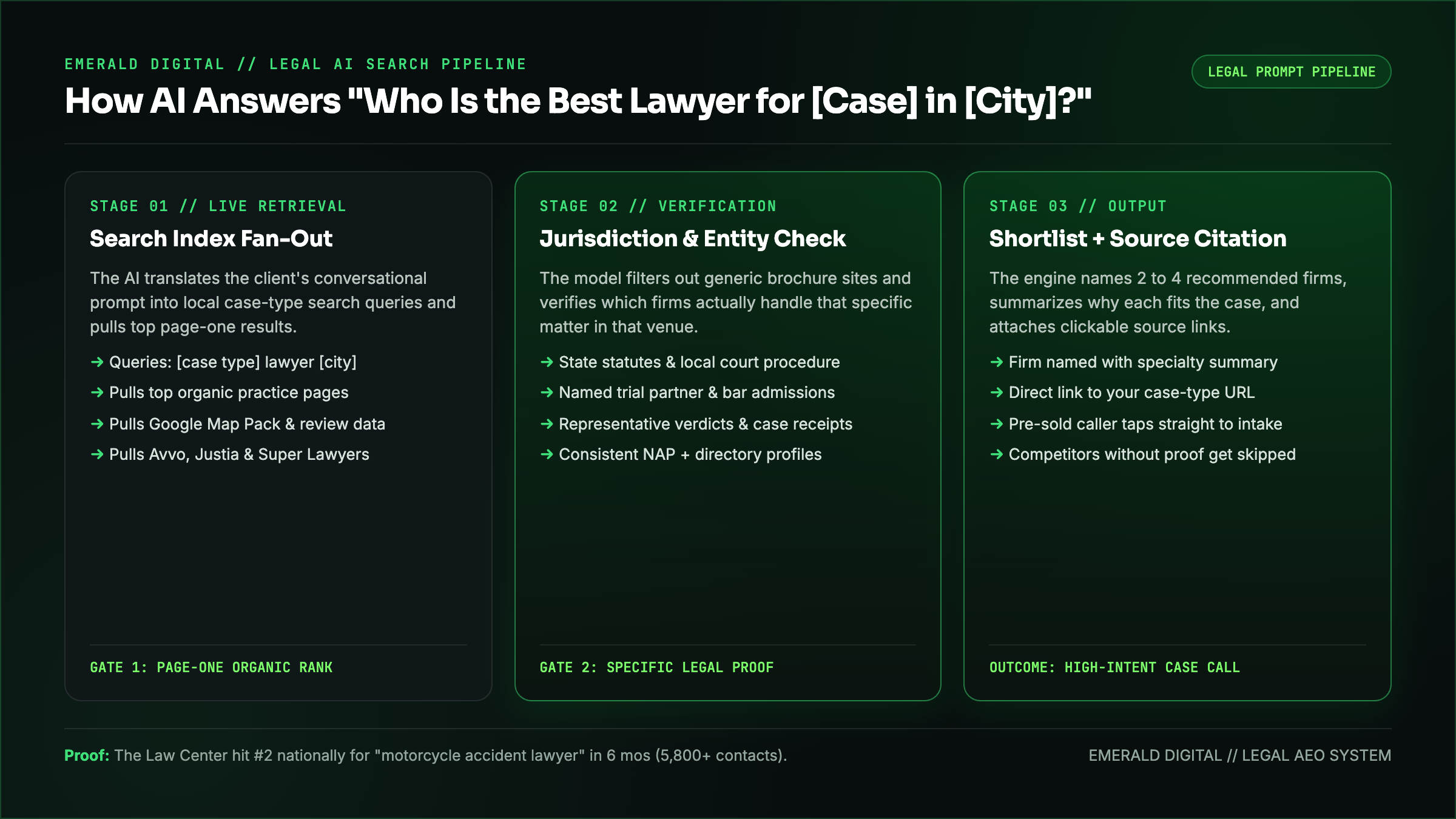
When an AI engine answers a prompt like that, it does not pull names out of thin air. It runs live web searches in the background, cross-checks legal directories and review profiles, and cites a shortlist of two to four firms with clickable source links.
If your firm is on that shortlist with a direct link to your practice page, you get a pre-sold caller who already trusts your authority. If you are missing, your competitor gets the call without you ever knowing the search happened.
Here is how AI engines decide which attorneys to recommend and cite, and the six-part playbook we use to put law firms into those answers.
Why Traditional Law Firm Brochure Sites Fail in AI Search
Most law firm websites were built for an older era of search: a stately photo of a courthouse, a slogan about "fighting for the injured," and a 400-word practice page that says the exact same thing as fifty other firms in town.
When an AI retrieval system scans a page like that, it finds zero verifiable facts to ground a recommendation. Worse, because legal advice sits in a high-scrutiny category, AI engines lean heavily on specific jurisdictional detail, verifiable attorney credentials, and off-site corroboration before naming a firm.
To earn both the recommendation and the clickable citation link, your firm has to win two stages at once:
- Stage 1 (Retrieval): Your practice page and local profile must rank in the top organic results for the underlying case-type and city query so the AI engine actually pulls your URL into its working memory (which starts with ranking for your practice area instead of just your firm name).
- Stage 2 (Citation & Entity Consensus): Once your page is retrieved, it must present clear state-specific legal explanations, named trial attorney credentials, real case results, and consistent off-site directory signals so the model selects your firm as a trusted source.
| What the Client Asks AI | Why a Brochure Law Site Gets Skipped | What Earns the Shortlist & Citation Link |
|---|---|---|
| :--- | :--- | :--- |
| "Who is the best truck or motorcycle accident lawyer in [City]?" | All injury cases are lumped onto one 350-word `/personal-injury/` overview page with generic slogans | A dedicated case-type URL with state fault rules, trial partner credentials, and verified case results |
| "What happens after an uninsured driver crash in [State], and who should I call?" | Takes 500 words of filler to state the rule; zero statute numbers or local court procedures | Opens with the exact state statute, filing deadline, and UM/UIM claim steps in the first 150 words |
| "Which [City] litigation firm handles partnership or construction disputes?" | Google Business Profile is set to generic `Law firm` and legal directories are half-empty | Matching specialty pages, aligned Avvo/Justia/Super Lawyers profiles, and reviews naming the exact dispute type |
Next step
Build search visibility around the cases you want.
See how we rank law firms for the cases that payThe 6-Point Playbook to Get Your Law Firm Cited by AI
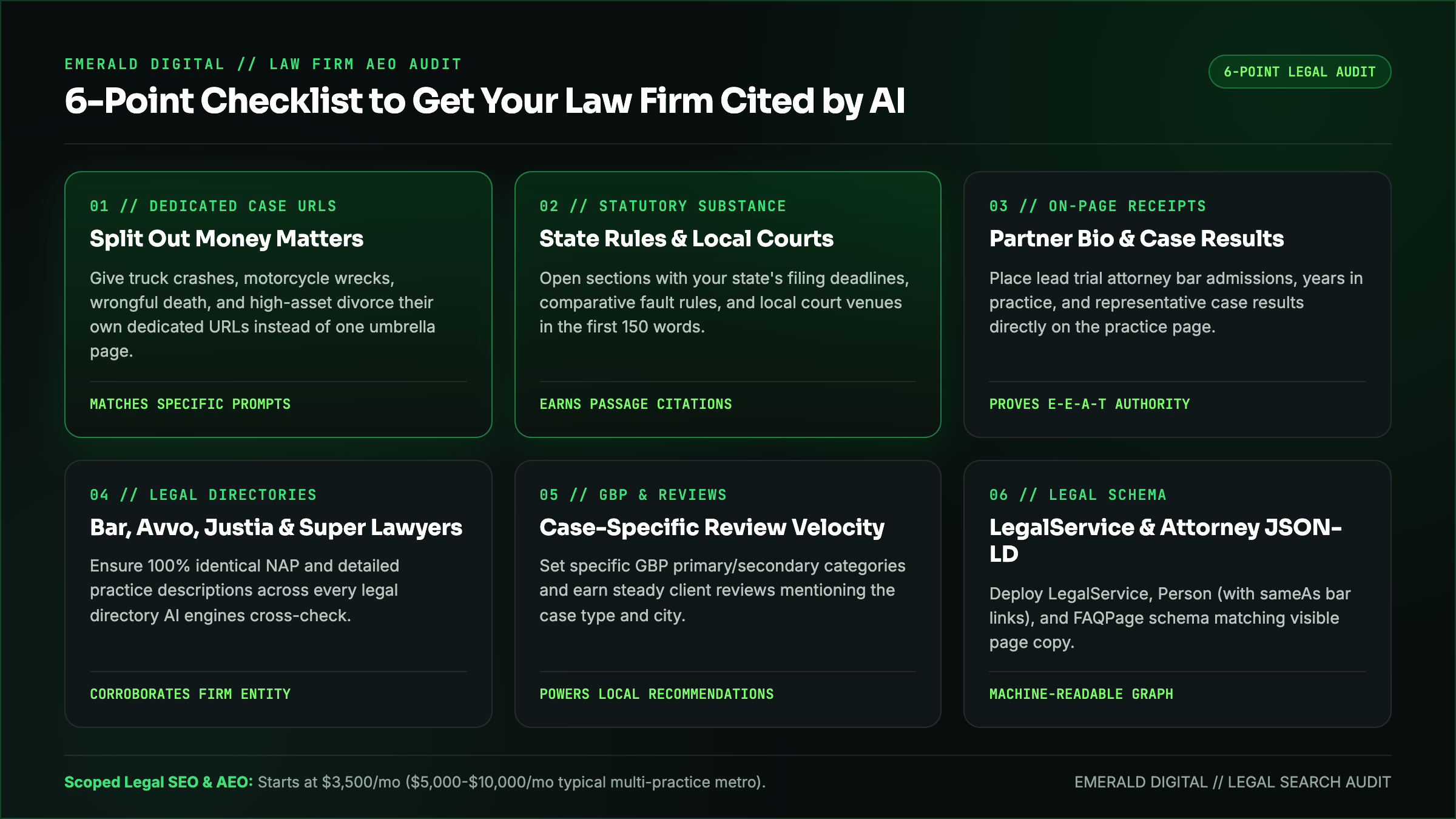
1. Build Dedicated Pages for High-Value Case Types, Not Just Broad Practice Umbrellas
When someone asks an AI engine for a lawyer, they almost always describe the specific accident, charge, or dispute. A generic "Personal Injury" or "Business Law" page loses to a dedicated page built for the exact matter.
Break your primary practice areas out into the specific cases you want to sign:
- Instead of only having `/personal-injury/`, build dedicated, high-depth pages for `/motorcycle-accident-lawyer/`, `/commercial-truck-accident-lawyer/`, `/wrongful-death-attorney/`, and `/rideshare-accident-lawyer/`.
- Instead of only having `/family-law/`, build dedicated pages for `/high-asset-divorce-lawyer/`, `/child-custody-modification-attorney/`, and `/prenuptial-agreement-lawyer/`.
When we built the organic search engine for The Law Center, we focused relentlessly on commercial case-type authority, taking a brand-new domain to #2 nationally for "motorcycle accident lawyer" in six months and generating 5,800+ contacts, 30+ qualified leads per day, and a 5x increase in signed cases. Owning the underlying practice query is what forces AI retrieval engines to pull your page first.
2. Write Answer-First Sections With Real State Statutes and Court Procedure
AI models cite pages that explain how the law actually works in your jurisdiction. Strip out the generic filler about how stressful legal problems are and replace it with concrete legal substance in the first 150 words of every section:
- Name your state's statute of limitations and any shorter notice deadlines for government or municipal claims.
- Explain how your state's comparative fault or negligence threshold affects recovery when an insurer tries to blame the victim.
- Reference the actual local courts and venues where your cases are filed (for example, the 24th Judicial District Court in Jefferson Parish or the Harris County Civil District Courts).
- Include a clean HTML table or bulleted breakdown of what happens in the first 30, 60, and 90 days of a claim.
3. Put Named Attorney Credentials and Verifiable Case Receipts on the Practice Page
Do not trap your best credibility signals on an isolated "About Us" or "Verdicts" tab that retrieval crawlers never pair with your practice page. Every money page on your site should visibly state:
- Which specific partner or trial attorney leads that practice group, including their state bar admissions, years in practice, board certifications, and trial background.
- Representative case results, verdicts, or settlements handled by your firm in that practice category (written in full compliance with your state bar's advertising rules).
- An author or legal reviewer byline linking directly to the attorney's bio page.
4. Lock In Entity Consensus Across Legal Directories and Bar Profiles
When ChatGPT or Perplexity evaluates whether a law firm is legitimate in a city, it cross-checks the firm against trusted legal directories that frequently rank on page one: Avvo, Justia, Super Lawyers, FindLaw, Martindale-Hubbell, Best Lawyers, Chambers, and your state bar directory.
Audit your firm's footprint across every one of those platforms:
- Make sure your firm name, office address, phone number, website URL, and primary practice areas match your website and Google Business Profile with zero discrepancies.
- Flesh out the practice-area descriptions on your directory profiles so they reinforce the exact case types you want to be recommended for, rather than leaving them half-blank.
5. Build Case-Specific Review Velocity on Your Google Business Profile
Local AI prompts heavily weight your Google Business Profile categories, review count, and review text. When satisfied clients leave a review, guide them (within ethical bounds) to mention the general type of legal matter and the city where you helped them. A steady stream of recent reviews mentioning your practice area gives both the Google Map Pack and AI answer engines fresh third-party proof that your firm is active and trusted right now.
6. Implement Clean `LegalService` and `Attorney` Schema Markup
Help search and AI crawlers parse your firm's relationships unambiguously by adding clean JSON-LD structured data to your pages:
- Use `LegalService` (or `Attorney`) schema on your location and practice pages with accurate `areaServed`, `address`, `telephone`, and `knowsAbout` properties listing your exact practice areas.
- Use `Person` schema on attorney bio pages with `alumniOf`, `memberOf`, and `sameAs` links pointing to their official state bar profile, Super Lawyers profile, Avvo profile, and LinkedIn.
- Use `FAQPage` schema on practice pages where you answer specific jurisdictional client questions.
Want to See Which Law Firms AI Recommends in Your Market Right Now?
You do not have to guess whether ChatGPT, Perplexity, and Google AI Overviews are sending cases to your firm or handing them to the firm across the street. Our legal SEO and AI search programs start at $3,500/month for focused single-market scopes, with competitive multi-practice campaigns typically running $5,000 to $10,000/month.
Explore our law firm SEO program and our AI search methodology, or request a free legal SEO & AI citation teardown. We will test your core practice-area prompts across the major AI engines, show you the exact pages and directories your competitors are riding on, and give you a clear 90-day roadmap to own those citations.