Patients, caregivers, and healthcare procurement teams no longer start their research by clicking ten separate blue links. They ask Google AI Overviews, ChatGPT, or Perplexity a direct clinical or operational question: *"What is the difference between staged bone grafting and immediate-load implants?"*, *"Which clinical trials are recruiting for Canavan disease gene therapy?"*, or *"What should a hospital look for in a regional medical supply partner?"*
The AI engine synthesizes a single answer, outlines the clinical criteria, and cites two or three trusted sources. If your organization is cited in that summary, the patient or buyer clicks through with high trust already established. If your pages are vague, anonymous, or trapped behind messy site architecture, the AI engine summarizes your category using your competitors' pages instead.
Healthcare AI search optimization is the engineering and editorial system that makes your clinical expertise retrievable, verifiable, and safe for answer engines to cite. Using this exact search foundation, we helped [Myrtelle](/case-studies/myrtelle) grow organic traffic 310% YTD (+263% top-3 rankings and #1 for "ASPA gene therapy") and led a 14,000-page catalog migration and indexation recovery for [Dealmed](/case-studies/dealmed). Here is how to build clinical pages that win both organic rankings and AI citations.
How AI answer engines evaluate healthcare sources
When an answer engine responds to a healthcare query, it runs a two-stage pipeline: retrieval followed by synthesis and citation. We break down the mechanics of this pipeline across all industries in our guide to AEO vs. SEO and our deep dive into Generative Engine Optimization (GEO).
In healthcare, however, both stages apply a much stricter filter.
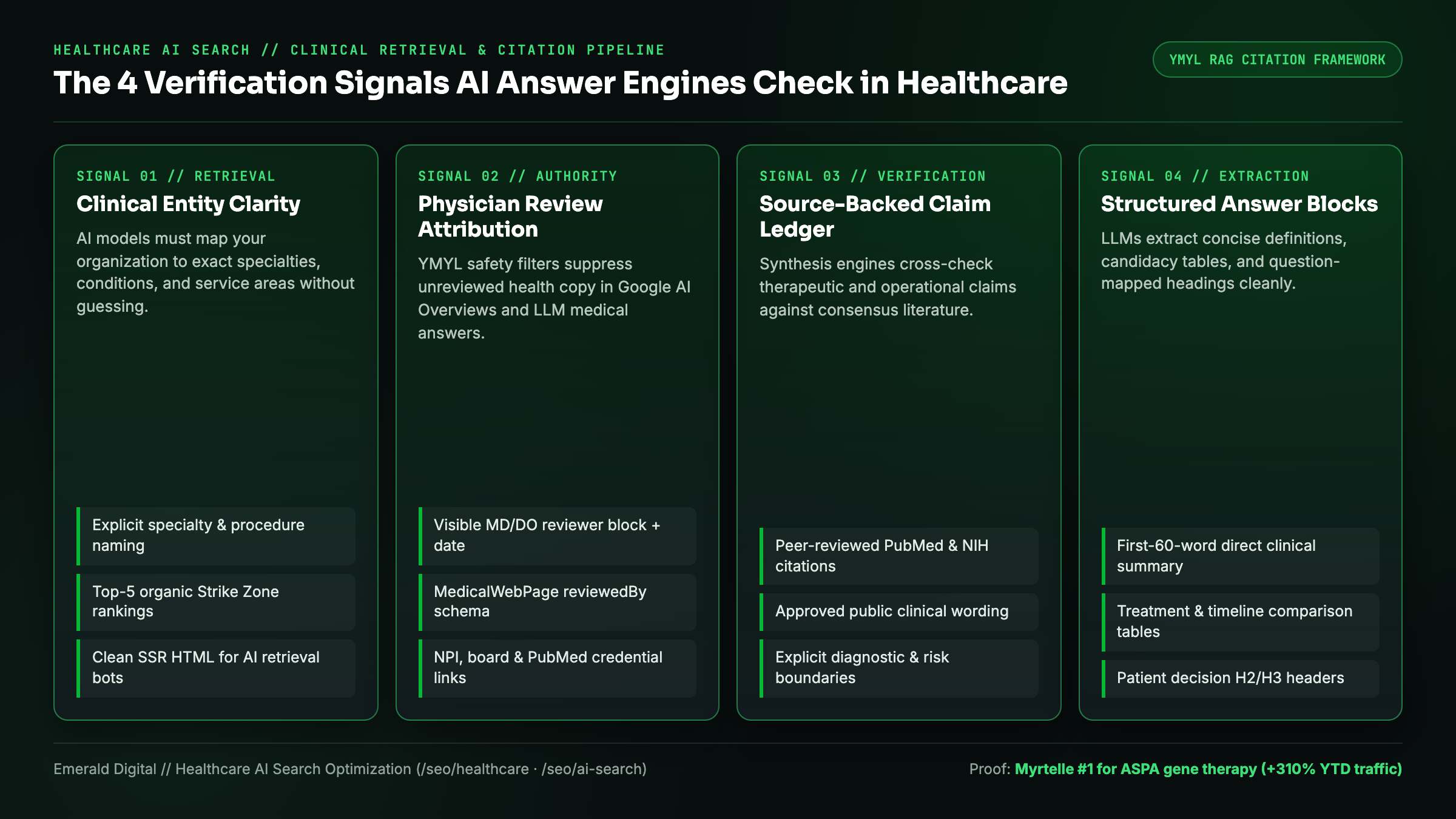
Because medical misinformation carries real-world harm, retrieval and synthesis models suppress pages that read like unverified sales brochures. To earn the citation, your page must pass four clinical verification checks:
- Unambiguous Clinical Entity Clarity: The model must immediately understand who you are, which specialties or conditions you treat, where you operate, and who your clinicians are. If your homepage and service pages hide behind vague phrases like "holistic wellness solutions" or "next-generation care delivery," the model cannot map your entity to a specific clinical prompt.
- Visible Physician & Specialist Review: Anonymous health content is a primary suppression trigger in YMYL search. Every clinical page needs a named author, a qualified medical reviewer (`reviewedBy` in JSON-LD), and a last-reviewed timestamp connected to a full provider bio page.
- A Defensible Claim Ledger: AI systems cross-check medical statements against consensus clinical literature. When you state an outcome, diagnostic threshold, or mechanism of action, anchor it to peer-reviewed literature (PubMed, NIH, specialty society guidelines) or your own published clinical data.
- Extractable Answer Architecture: Large language models and AI Overviews favor pages that answer the core clinical or operational question in the first 60 words of a section, followed by structured comparison tables, candidacy checklists, and clear boundaries on when to consult a specialist.
| Healthcare Query Type | What the Patient or Buyer Prompts | Why Generic Healthcare Pages Get Ignored | What Earns the AI Citation |
|---|---|---|---|
| Condition & Mechanism Research | "How does ASPA gene therapy work for Canavan disease?" | Vague 400-word blog posts with no scientific references or specialist attribution | Direct mechanism summary in the first paragraph, peer-reviewed citations, and clinician-reviewed depth (how we ranked Myrtelle #1) |
| Treatment Comparison & Candidacy | "Anterior vs posterior hip replacement recovery timeline by week" | Sales copy that promises "faster recovery" without specifying surgical criteria or week-by-week milestones | Structured comparison table of surgical approaches, explicit candidacy rules, and realistic rehabilitation phases reviewed by the orthopedic surgeon |
| Provider & Specialty Selection | "What credentials should a pediatric neurologist have for rare genetic disorders?" | Thin clinic pages that say "our caring team is here for you" without listing board certifications or fellowships | Detailed provider bios with Physician schema, sub-specialty board certifications, hospital privileges, and published research links |
| B2B Healthcare & Supply Chain | "How to evaluate a medical surgical distributor for multi-site ambulatory clinics" | Unstructured product grids or gated PDF brochures that crawlers cannot parse | Clean category architecture, indexable technical specifications, and transparent fulfillment standards (like our 14,000-page Dealmed overhaul) |
The dangerous trap in healthcare AI SEO
Whenever a new search acronym gains traction, vendors start selling shortcuts. In healthcare, the worst mistake you can make is using generative AI to mass-produce hundreds of unreviewed symptom or treatment articles in an attempt to "capture long-tail prompts."
That approach backfires for three reasons:
- Sitewide quality dilution: Google's Helpful Content system evaluates content quality across your entire domain. Flooding a clinic or biotech site with 200 thin AI-generated health articles drags down the ranking power of your core commercial service-line pages.
- Hallucinated or unapproved clinical claims: Unreviewed copy inevitably drifts into diagnostic promises, off-label implications, or inaccurate recovery timelines that create compliance and reputational risk with your medical board and legal team.
- Zero citation differentiation: Answer engines do not need your website to repeat generic textbook definitions they already hold in their training weights. They cite external web pages when those pages contribute specific clinical protocols, verified statistics, structured comparisons, or credentialed specialist perspective.
"In healthcare, AI search optimization is not about using AI to write more medical blogs. It is about structuring your real doctors' clinical protocols, candidacy rules, and verified outcomes so answer engines can quote your organization without distorting the medicine."
Matthew Berman, founder, Emerald Digital
The page-level readiness checklist for clinical AI citations
Before creating any new content, upgrade the high-value service-line, condition, and provider pages that carry your organization's revenue and reputation.
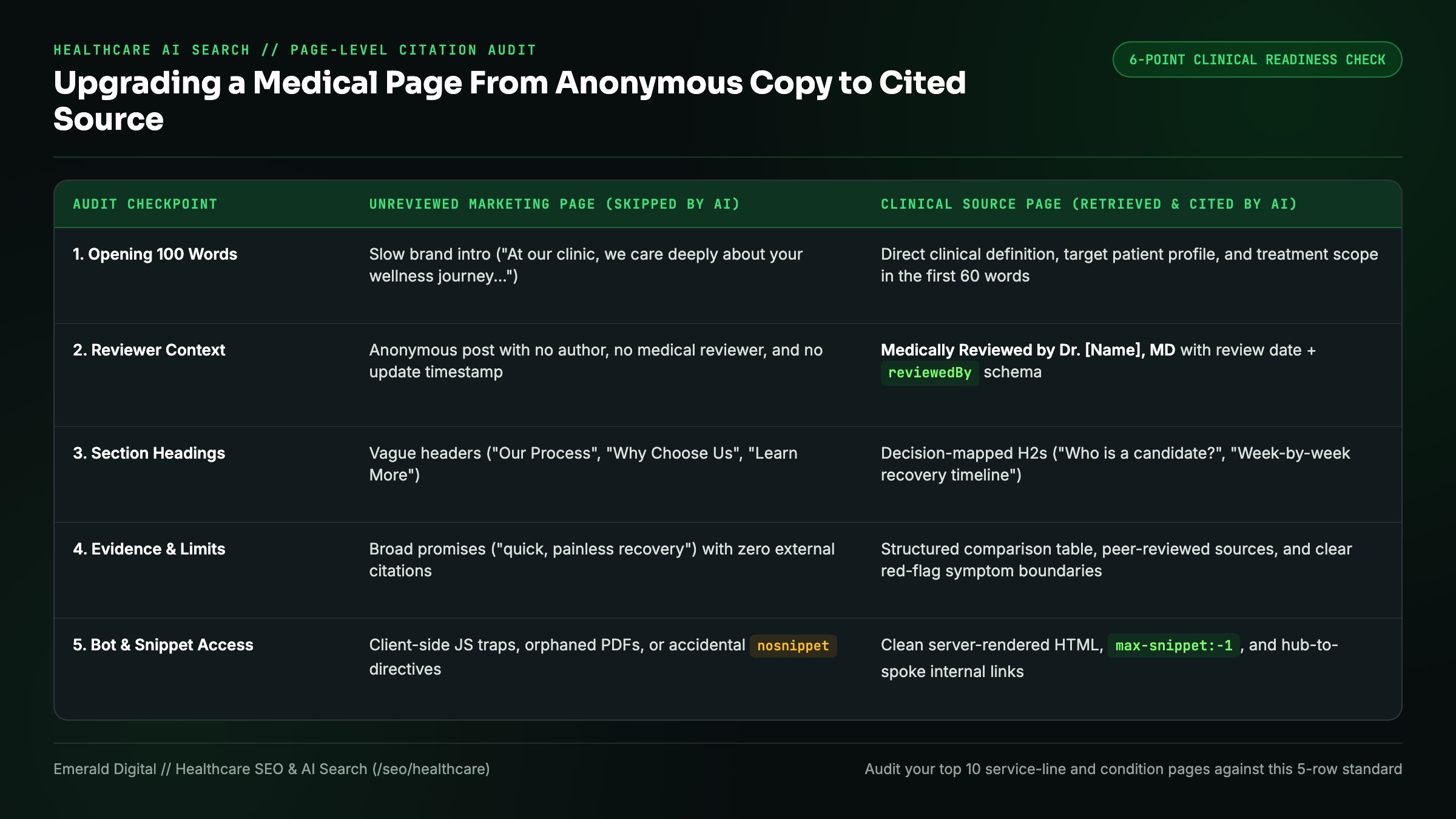
Use this six-point engineering and editorial table to audit your top ten healthcare pages:
| Audit Layer | Technical or Editorial Check | How to Implement It on Your Domain |
|---|---|---|
| 1. First-100-Word Direct Answer | Does the page define the procedure, condition, or service and who it is for in the opening block? | Replace slow brand introductions with a concise, plain-English clinical summary that an AI Overview can extract verbatim. |
| 2. Reviewer Attribution & Schema | Can a human and a crawler verify who wrote and medically reviewed the page? | Add a visible reviewer block ("Medically reviewed by Dr. [Name], [Credentials] on [Date]") and wire MedicalWebPage `reviewedBy` to the doctor's bio URL. |
| 3. Question-Mapped H2/H3 Headings | Do section headers match the real decision questions patients and referral partners ask? | Rewrite vague headers like "Our Approach" into specific queries: "Who is a candidate for [Procedure]?" and "What happens during the first 14 days of recovery?" |
| 4. Structured Comparison & Risk Boundaries | Are options, timelines, and clinical limits presented in scannable tables and lists? | Include a comparison table of treatment alternatives, a bulleted list of preparation steps, and a clear note on when to seek urgent medical evaluation. |
| 5. Crawler & Snippet Access Controls | Can search and AI retrieval bots access the page without rendering or directive blocks? | Verify clean server-side HTML rendering, check `robots` meta tags (`max-snippet:-1`), and eliminate accidental `noindex` rules or duplicate facet traps. |
| 6. Hub-and-Spoke Internal Linking | Does every condition guide connect clearly to the corresponding service line and specialist? | Link every educational article directly to the commercial treatment page, the performing physicians' bios, and the relevant clinic locations. |
How we build healthcare search and AI visibility systems
At Emerald Digital, we do not sell AI search optimization as a disconnected trend deck. We run it as an integrated layer inside our healthcare SEO architecture:
- Audit current organic rankings and AI prompt citations. We test how Google Search, Google AI Overviews, ChatGPT, and Perplexity currently describe your core service lines, therapies, or product categories, identifying where competitors are cited and which source gaps hold you back.
- Fix technical indexation and commercial page architecture. Whether you operate a 14,000-SKU medical catalog like Dealmed or a specialized clinical platform like Myrtelle, we clean up crawl bottlenecks, duplicate paths, and schema markup first.
- Upgrade Strike Zone service lines with clinician-reviewed depth. We interview your subject-matter experts, build a verified claim ledger, and overhaul the pages ranking in positions 5 to 20 so they enter the top 5 organic results (the primary retrieval pool for AI answer engines).
- Build third-party entity corroboration. We align your organization's entity data across medical directories, research citations, industry press, and knowledge graphs so generative models recognize your authority across the web.
Our healthcare SEO and AI search retainers start at $3,500/month for focused single-specialty practices and $5,000 to $10,000/month for multi-location medical groups, biotech companies, and enterprise healthcare brands, built on our open-source agentic workflow (the seo-kit on GitHub).
Review our healthcare SEO approach, explore our AI search optimization services, or request a free clinical AI visibility teardown to see exactly how search and answer engines treat your brand today.