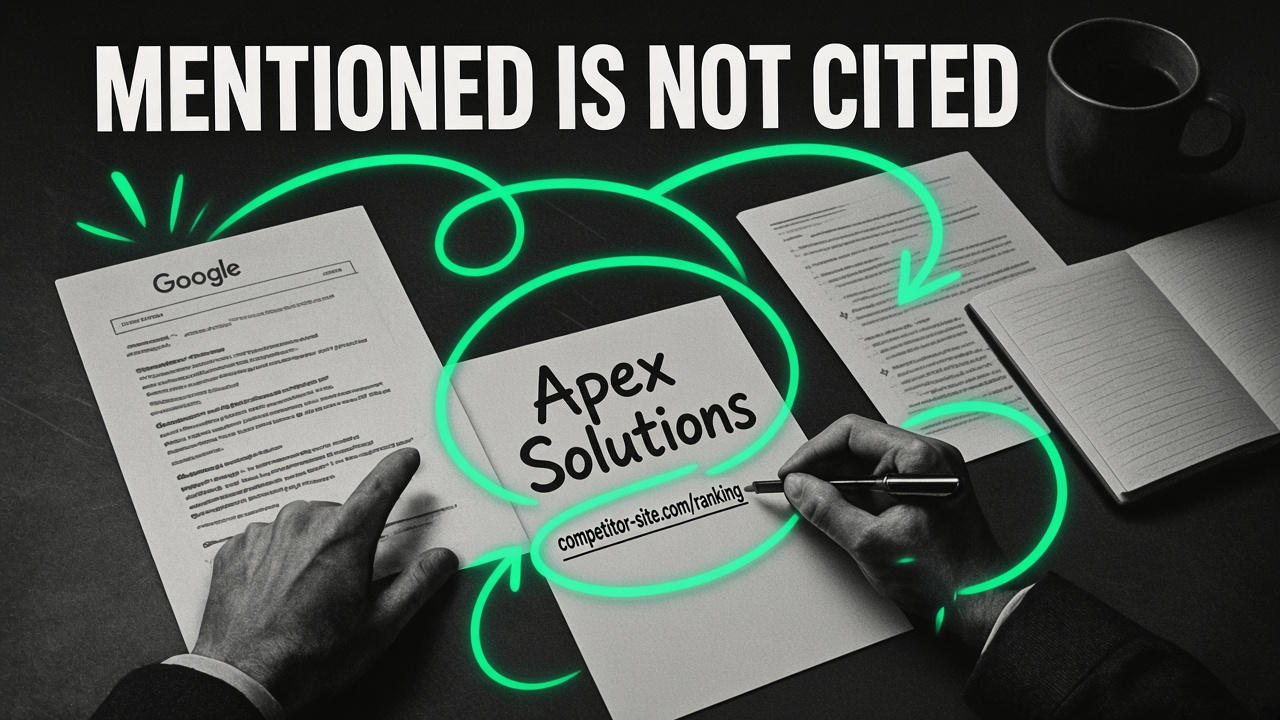
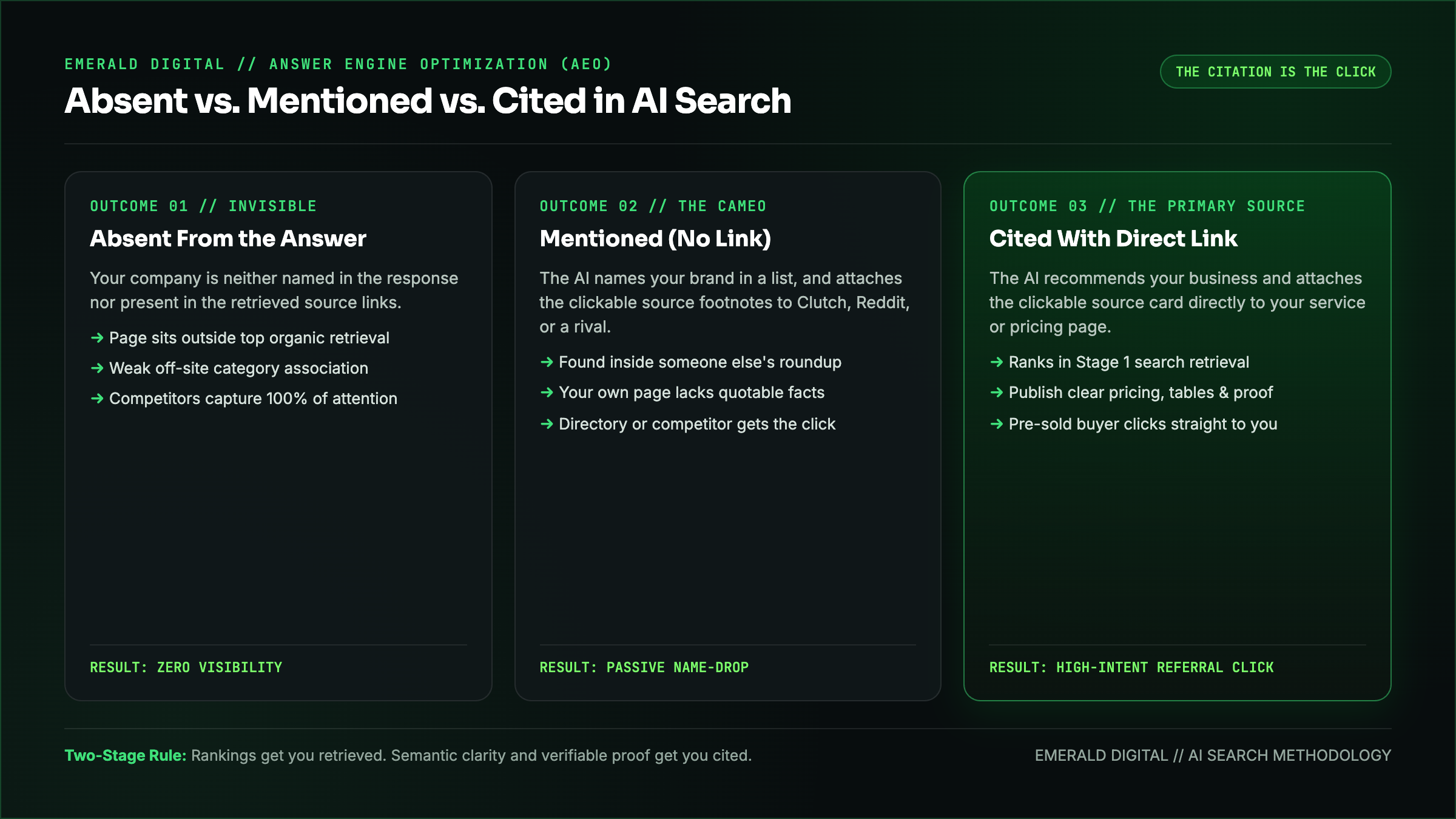
When a prospective buyer asks ChatGPT, Perplexity, Claude, or Google AI Overviews who to hire or how a service works, your business will land in one of three places:
- Absent: Your company is not in the answer at all.
- Mentioned: The AI names your company in the paragraph, and then attaches the source footnotes and clickable links to a directory, a Reddit thread, or a competitor's guide.
- Cited: The AI uses your page as the primary source and attaches the clickable reference link directly to your domain.
Most founders test a few prompts, see their company name appear in a bulleted list, and assume they are winning AI search. Then they look closely at the source cards on the right side of the screen and realize every clickable link points somewhere else.
Being mentioned builds familiarity. Being cited wins the click. Here is how the two outcomes differ underneath the hood, why AI models name-drop one company while linking to another, and how to turn your pages into the cited source.
The Difference Between a Mention and a Citation
AI answer engines do not generate responses in a single step. Modern systems run a two-stage pipeline: entity memory plus live search retrieval.
First, the model knows which brands, firms, and products are frequently associated with a category across the open web. Second, when a user asks a question that requires current facts, pricing, comparisons, or local verification, the system retrieves live web pages from its search index to ground the answer and attach source links.
| Outcome | What the Buyer Sees on Screen | Where the Click Goes | Why the Model Treated You This Way |
|---|---|---|---|
| :--- | :--- | :--- | :--- |
| Absent | Competitor names and third-party source cards only | To your competitors and industry directories | You lack both category authority across the web and a page that ranks in the retrieval window for that prompt |
| Mentioned (No Link) | Your brand name appears in the text, while the footnote badge links to Clutch, G2, Avvo, Reddit, or a competitor blog | To the third-party roundup or competitor page that listed you | The model found your name inside someone else's listicle or directory, while your own site gave it no quotable, structured source page to cite |
| Cited (Source Link) | Your brand is named and your page is attached as the clickable source chip or footnote card | Directly to your service page, comparison page, or pricing guide | Your page entered the live retrieval set and contained clear, verifiable facts, pricing, or methodology the model could quote directly |
That is our core rule for Answer Engine Optimization: rankings get you retrieved; semantic clarity and verifiable proof get you cited.
Why You Get Mentioned Without Getting the Link
When we audit a company that gets named in ChatGPT or Google AI Overviews without earning the source link, the leak almost always traces back to one of four issues (and if a rival is getting named over you entirely, see our breakdown of why AI recommends your competitor instead of you):
1. Third-Party Roundups Outrank Your Own Category Page
If a buyer asks `who are the best commercial roofing contractors in Dallas` or `best law firm SEO agencies`, the retrieval engine pulls the top organic search results for that query. If eight of the top ten organic results are directory listicles, review aggregators, and agency roundup blogs, the AI reads your name off those pages and cites the roundup URL as its source. Your brand gets a passing nod, and the directory gets the traffic.
2. Your Service Pages Read Like Vague Brochures Instead of Source Material
Language models attach citations to specific claims: pricing ranges, timelines, step-by-step processes, regulatory rules, and named case metrics. If your service page consists of three paragraphs of abstract positioning ("we deliver tailored, cutting-edge solutions for growing brands"), there is nothing factual on the page that requires a footnote. The model mentions your name and links to the competitor who actually published the pricing table or diagnostic checklist.
3. Your Best Proof Is Locked Inside PDFs, Video Files, or Uncrawlable Scripts
If your pricing guide sits behind an email gate, your technical specs live inside a downloadable PDF, or your case study metrics only appear inside a video player with no HTML transcript, retrieval crawlers skip right past them. If it is not in clean, indexable HTML text on the page, the model cannot quote it.
4. Your Page Takes 600 Words to Answer the Question
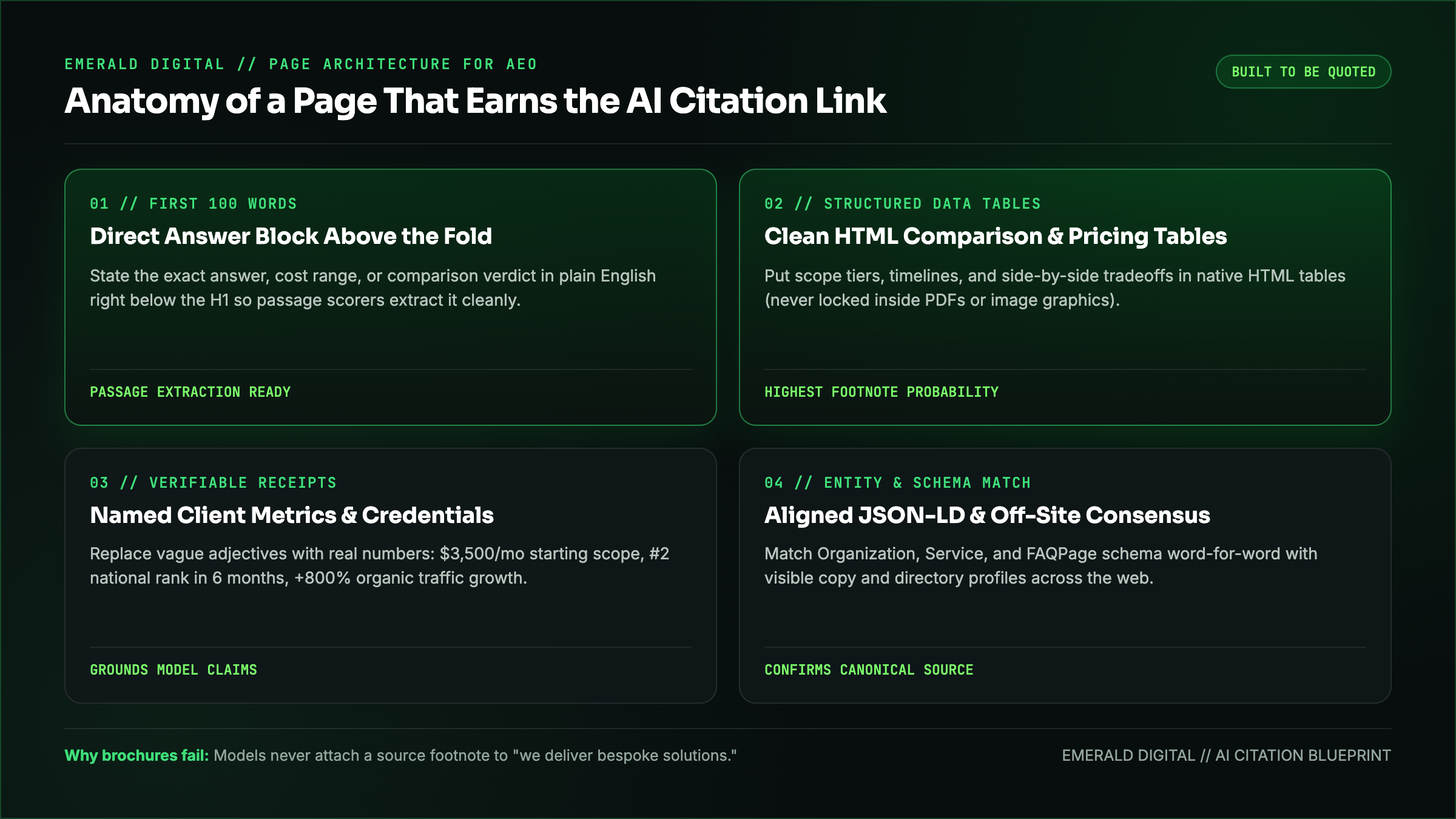
AI retrieval systems slice web pages into passages. When a page buries the actual answer underneath four paragraphs of throat-clearing intro copy, the passage scorer grades it lower than a page that states the direct answer, the cost range, or the comparison verdict in the first 100 words.
How to Turn Unlinked Mentions Into Direct Citations
You do not need gimmicky prompt-injection tricks to earn the citation link. You need pages that win organic retrieval and hand the model structured, verifiable facts it cannot get from a generic directory.
1. Build the Page That Answers the Exact Prompt Category
Look at the prompts where your brand is currently mentioned without a link. What URL is the AI citing instead?
- If the AI is citing a competitor's pricing breakdown, publish a transparent cost and scope section on your service page or a dedicated pricing guide.
- If the AI is citing a third-party comparison roundup, build a rigorous comparison or buyer's evaluation guide on your own domain with a real side-by-side HTML table.
- If the AI is citing a how-it-works explainer, add a clear, numbered methodology block to your commercial page.
2. Lead Every Core Section With a Quotable Answer Block
Right underneath your H1 and each major H2, write a two-to-three sentence summary that directly answers the heading in plain English before expanding into nuance. Pair that summary with a clean HTML table or a numbered list so both human skimmers and passage extractors can pull the exact structure cleanly.
3. Put Verifiable Numbers and Named Receipts on the Page
Generic claims never earn footnotes; specific data does. On our own pages, we state specific scope and verified outcomes rather than vague promises:
- Clear pricing context: Focused SEO programs start at $3,500/month, with typical competitive engagements running $5,000 to $10,000/month.
- Named, verifiable client outcomes: Taking The Law Center from a brand-new domain to #2 nationally in 6 months (5,800+ contacts and 5x signed cases), growing DuJour organic traffic by +800% in 9 months, and driving +2,000% YoY organic traffic for Berman Property Solutions.
Give your own pages that same level of specificity: real timelines, real deliverables, real jurisdiction or product specs, and named client results.
4. Align Your Schema and Off-Site Entity Footprint
Make sure your `Organization`, `LocalBusiness` (or `LegalService` / `MedicalBusiness`), `Service`, and `FAQPage` structured data match the visible copy on your site word-for-word. Keep your company description, core services, primary categories, and location details consistent across your website, Google Business Profile, LinkedIn, and industry directories so the model never hesitates to connect your brand entity to your canonical URL.
Want to See Where AI Mentions You vs. Cites Your Competitors?
We track both stages of AI search: whether your pages are ranking in the retrieval window and whether answer engines are citing your URLs or handing those clicks to your competitors.
See how our two-stage methodology works on our AI Search & AEO page, or request a free AI search and SEO teardown. We will run your core buyer prompts across ChatGPT, Perplexity, and Google AI Overviews, show you who owns the citation links today, and map the exact page upgrades required to win them.